Your Brain May Be Aging Faster Than You Think: What You Can Do About It Today

After seeing patients for over thirty years, I notice people spend far too much time thinking about brain health only after memory, concentration, or cognitive problems begin. Your brain is influenced by what is happening throughout your body, including your cardiovascular health, metabolism, sleep, inflammation, physical activity, and everyday habits.
While we cannot control every risk factor for Alzheimer's disease or other forms of cognitive decline, emerging research continues to reinforce that there are factors we may be able to influence. The goal is not to promise that dementia can always be prevented, because it cannot. This week, let's identify risks earlier and make thoughtful choices today that may help protect cognitive function, independence, and quality of life in the years ahead.
-Dr. John Salerno
The Brain Health Problems We Need to Think About
"Brain health" is a broad term. Memory loss receives much of the attention, but different neurological conditions affect the brain in different ways.
Some primarily affect memory and reasoning. Others can affect movement, language, personality, judgment, attention, or the ability to perform everyday activities. Symptoms can also overlap, making it important to investigate persistent or progressive changes instead of assuming they are simply part of getting older. Among the conditions and cognitive concerns patients and families should understand are:
- Alzheimer's Disease - Alzheimer's Disease is a progressive neurodegenerative disease and a major cause of dementia. Although memory problems are commonly associated with it, Alzheimer's can eventually affect thinking, reasoning, communication, behavior, and the ability to function independently. If someone notices persistent cognitive changes, they should not try to diagnose the cause based solely on symptoms.
- Dementia - Dementia describes a decline in cognitive abilities significant enough to interfere with everyday functioning. It is not one single disease, and Alzheimer's is one cause of dementia. Different conditions can produce different patterns of memory, language, reasoning, behavior, or functional changes.
- Parkinson's Disease - Parkinson's is commonly associated with movement symptoms, but the disease can also involve nonmovement symptoms, and some patients experience cognitive changes. Because Parkinson's can present differently from person to person, recognizing changes and obtaining an individualized evaluation is important.
- Other Neurodegenerative Diseases - Alzheimer's and Parkinson's are not the only disorders that can progressively affect the nervous system. Neurodegenerative conditions can influence cognition, movement, behavior, coordination, and other neurological functions. Understanding the underlying condition matters because "brain decline" is not a single diagnosis.
- Brain Fog and Cognitive Changes - Brain fog is not the same thing as dementia. People commonly use the term to describe problems with concentration, mental clarity, memory, or processing information. Because these symptoms can have numerous possible causes, persistent brain fog deserves attention rather than being automatically attributed to age.
Recognizing these differences is important. The question should not simply be, "Am I becoming forgetful?" A better question is, "Has something changed from what is normal for me?"
What Can You Do Today to Protect Tomorrow's Brain?
No diet, supplement, exercise program, or medical treatment can guarantee that someone will never develop Alzheimer's disease or dementia. But that does not mean prevention is powerless.
The 2024 Lancet Commission identifies multiple potentially modifiable dementia risk factors, underscoring the connection between long-term cognitive health and areas such as cardiovascular and metabolic health, physical activity, sensory health, smoking, alcohol exposure, social isolation, depression, traumatic brain injury, and environmental factors. A smart brain-health strategy therefore looks beyond memory exercises alone.
- Take cardiovascular health seriously. Your brain needs a steady blood supply, so vascular health is an important part of protecting neurological function. Blood pressure, cholesterol, and other cardiovascular risks deserve attention throughout adulthood. Salerno Wellness also addresses cardiovascular support treatments in NYC as part of overall health.
- Pay attention to metabolic health. Blood sugar regulation and metabolic health matter well beyond weight. Diabetes is among the potentially modifiable factors considered in dementia-prevention research.
- Move your body consistently. Physical inactivity is another potentially modifiable risk factor identified by dementia prevention research. Exercise also supports cardiovascular and metabolic health, so its benefits extend well beyond muscles and weight.
- Make sleep a health priority. Don't accept poor sleep as just part of a busy life or getting older. Persistent snoring, disrupted sleep, daytime sleepiness, or suspected sleep apnea should be discussed.
- Stop smoking and limit harmful alcohol use. Both smoking and excessive alcohol consumption have been identified among potentially modifiable dementia risk factors. Reducing these risks also benefits cardiovascular and overall health.
- Stay socially and intellectually engaged. The brain benefits from being used. Relationships, conversation, learning, hobbies, reading, music, problem-solving, and meaningful social activity keep us engaged with the world. Social isolation has also been examined as a potentially modifiable risk factor for dementia.
- Think in terms of longevity, not quick fixes. Protecting your brain is not a 30-day project. It means identifying health risks and making sustainable decisions that support the body and brain over time. That philosophy also shapes our approach to longevity health.
Early Warning Signs You Shouldn't Ignore
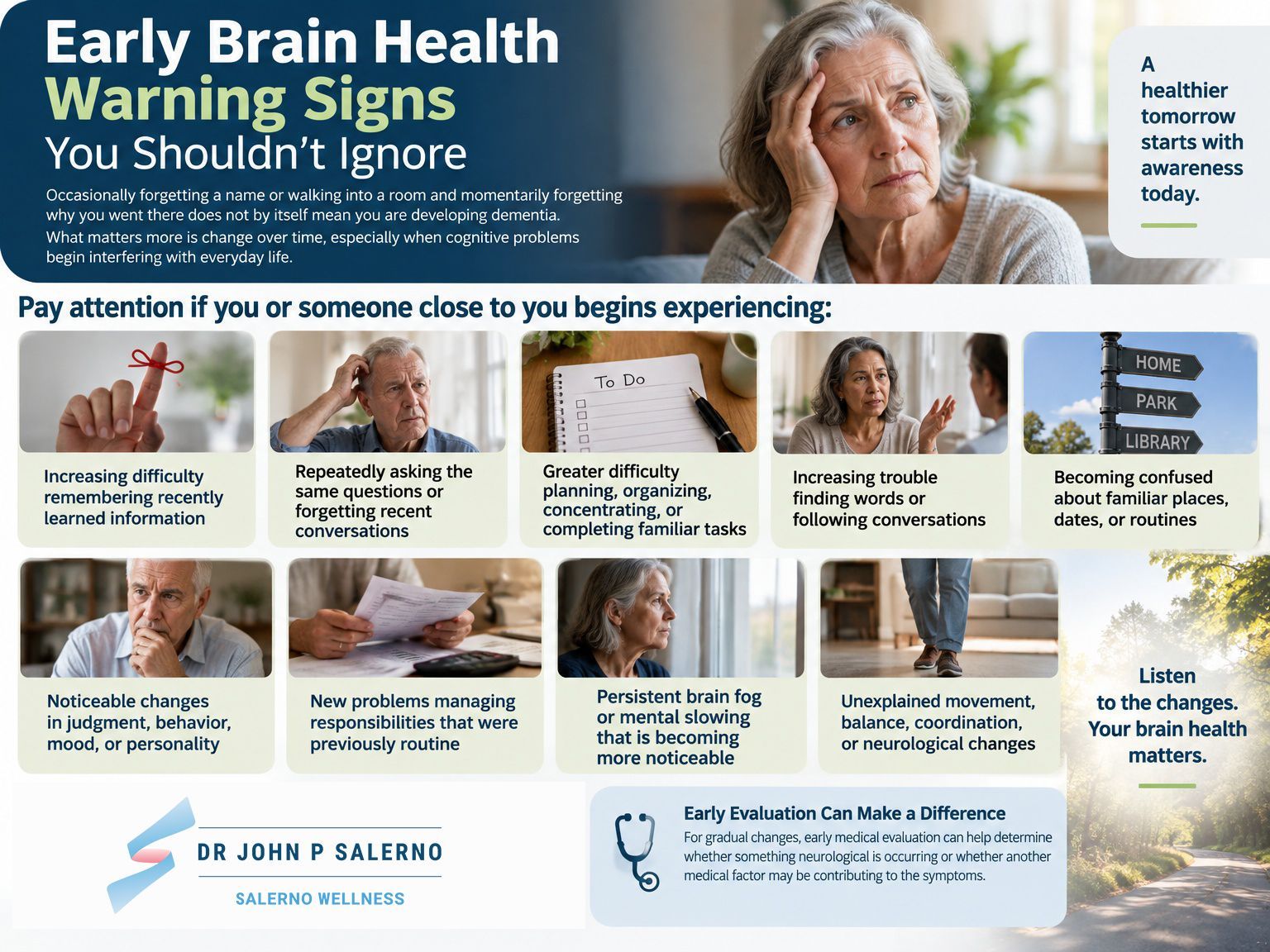
Occasionally forgetting a name or walking into a room and momentarily forgetting why you went there does not by itself mean you are developing dementia.
What matters more is change over time, especially when cognitive problems begin interfering with everyday life. Pay attention if you or someone close to you begins experiencing:
- Increasing difficulty remembering recently learned information
- Repeatedly asking the same questions or forgetting recent conversations
- Greater difficulty planning, organizing, concentrating, or completing familiar tasks
- Increasing trouble finding words or following conversations
- Becoming confused about familiar places, dates, or routines
- Noticeable changes in judgment, behavior, mood, or personality
- New problems managing responsibilities that were previously routine
- Persistent brain fog or mental slowing that is becoming more noticeable
- Unexplained movement, balance, coordination, or neurological changes
Any sudden neurological change, such as sudden weakness, numbness, difficulty speaking, severe confusion, trouble seeing, or loss of balance, may be a medical emergency and should be evaluated immediately.
For gradual changes, early medical evaluation can help determine whether something neurological is occurring or whether another medical factor may be contributing to the symptoms.
Don't Wait Until Memory Loss Becomes the Warning
One of the most important shifts in modern medicine is the growing emphasis on preserving health before disease advances. Let's apply that same thinking to the brain. If you have noticed changes in memory, concentration, mental clarity, sleep, or cognitive performance, or if you have a family history that concerns you about your future brain health, don't assume nothing can be done until symptoms become severe.
At Salerno Wellness, we can look at the bigger picture, including your medical history, metabolic and cardiovascular health, lifestyle, symptoms, and more, to help determine where attention may be warranted.
Your future brain health doesn't begin at 70 or 80. It's influenced by the health decisions you make today. Schedule a consultation to take a more proactive approach to your cognitive and long-term health.
Please contact us online or call us at (212) 582-1700 in New York City or (475) 269-2138 in Connecticut to schedule an appointment.