Walking Over 50: Every Step Counts More Than Ever
For adults over 50, decades of thinking about "enough" movement have been shaped by a single number—10,000 steps. Your watch celebrates it, your apps track it, and missing it can feel like failure. But modern research and the American Heart Association tell a more encouraging story: meaningful health benefits start well before 10,000 steps, and progression matters more than perfection.
This week, let's review what the latest science actually says, and how to turn it into realistic, sustainable goals. Think of this as a reset: instead of chasing a magic number, we're building a path you can walk—literally—one step at a time.
-Dr. John Salerno
Rethinking the 10,000 Steps Per Day
For years, 10,000 steps a day has been treated almost like a prescription. However, the number didn't come from medical guidelines. It originated from a 1960s Japanese pedometer called the manpo‑kei, marketed as a "10,000‑step meter"—catchy, memorable, and easy to sell.
The American Heart Association (AHA) has always focused on minutes and intensity, not step counts. Their recommendations: at least 150 minutes of moderate‑intensity aerobic activity per week, or 75 minutes of vigorous activity, plus muscle‑strengthening exercise at least twice weekly. Brisk walking is one of the most straightforward ways to meet those minutes, especially for adults over 50 who need joint‑friendly, sustainable movement.
What The 7,000 Step Study Found
A major 2025 meta‑analysis led by Professor Ding Ding at the University of Sydney examined daily steps and health outcomes across 57 studies and more than 160,000 participants. Instead of focusing only on lifespan, the researchers looked at cardiovascular disease, cancer, type 2 diabetes, dementia, depressive symptoms, falls, and death from any cause. One number kept appearing: Around 7,000 steps per day.
Key Health Associations Around 7,000 Steps
The study compared people averaging about 7,000 steps a day with those averaging roughly 2,000. The results were striking and highly relevant for adults over 50.
- Lower all‑cause mortality: Around 7,000 steps was associated with a 47% lower risk of death from any cause compared with 2,000 steps. This doesn't guarantee individual outcomes, but it strongly suggests that modest increases in daily movement can substantially affect longevity.
- Cardiovascular protection: Participants at 7,000 steps showed a 25% lower risk of developing cardiovascular disease and a 47% lower risk of cardiovascular death. For patients already working with us on Cardiovascular Support, walking becomes a core, accessible therapy—not an optional extra.
- Brain and mood benefits: The study found a 38% lower risk of dementia and a 22% lower risk of depressive symptoms at around 7,000 steps. For adults over 50 concerned about cognitive decline or mood changes, this positions walking as a daily, non‑pharmaceutical tool to support brain health and emotional resilience.
- Metabolic and cancer outcomes: There was a 14% lower risk of type 2 diabetes and a 37% lower risk of cancer death at 7,000 steps. Combined with targeted care for Metabolic Syndrome and Inflammation, walking becomes part of a comprehensive metabolic and anti‑inflammatory strategy.
- Fall risk reduction: The study also found a 28% lower risk of falls. For adults over 50, this is critical—falls drive disability and loss of independence, and walking helps maintain balance, strength, and confidence in movement.
These findings are based on observational evidence and meta‑analysis, not direct cause‑and‑effect. But the pattern is consistent: more movement is associated with better health, and substantial benefits appear well before 10,000 steps. For most patients, the biggest gains come from moving out of the "very low activity" range, not from chasing perfection.
Progression, Not Perfection: Building Realistic Step Goals
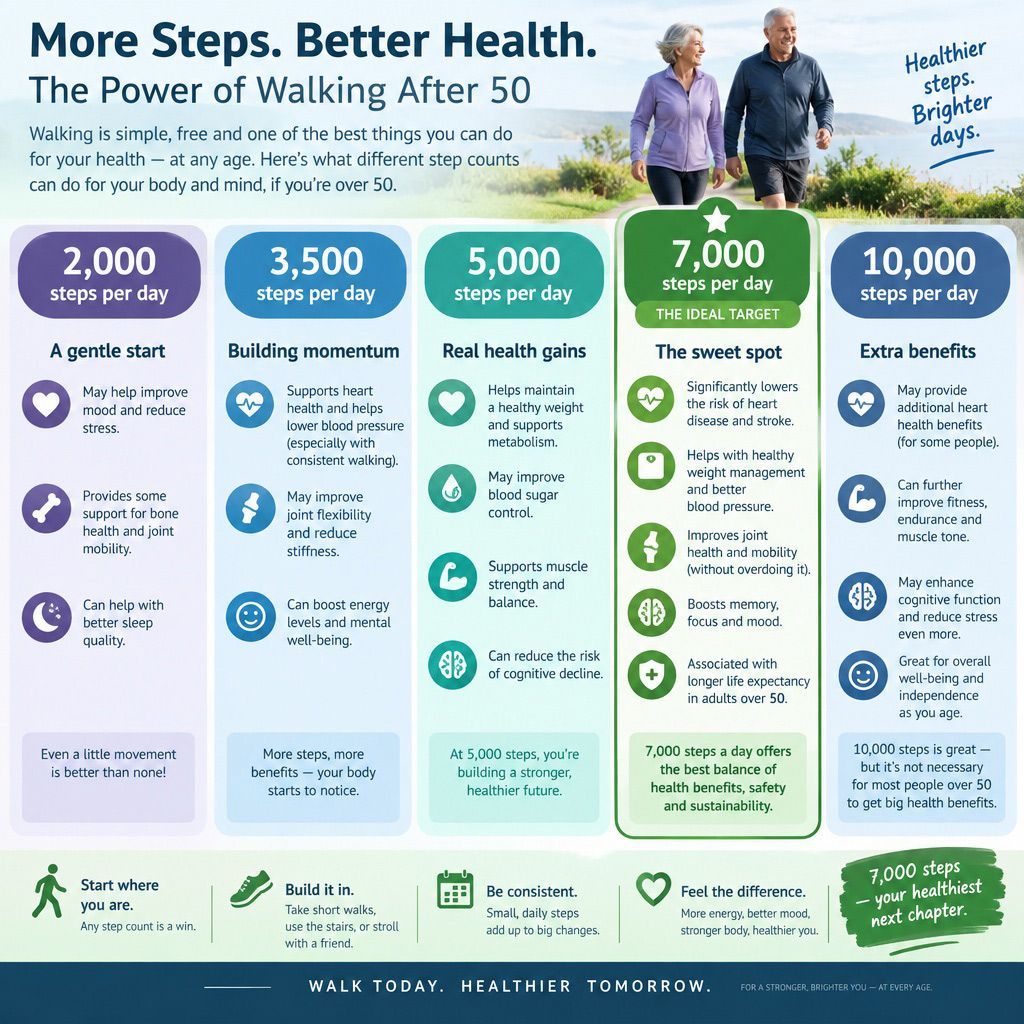
One of the most encouraging messages from the research is that you don't need to reach 7,000 steps for walking to matter. The University of Sydney highlighted that increasing daily steps from around 2,000 to 4,000 can produce substantial health gains. That changes how we should think about goals, especially for adults over 50 who may be starting from a mostly sedentary baseline.
How To Build Step Goals That Actually Stick
Instead of staring at 10,000 steps and feeling defeated, we can break the journey into achievable stages. The goal is progression—moving more than you do today, consistently, in a way your body can tolerate and your lifestyle can sustain.
- Start with your true baseline: If your watch or phone shows you average 2,000–3,000 steps per day, accept that number as data, not judgment. Knowing where you are is the first step toward change, and it lets us set realistic goals rather than aspirational ones.
- Add 1,000–2,000 steps at a time: Rather than jumping from 2,500 to 10,000, aim for 3,500, then 4,500, then 5,500. Each 1,000–2,000-step increase is meaningful and supported by research. This approach reduces frustration and lowers the risk of overuse injuries or burnout.
- Pair steps with minutes of intensity: Remember, slowly accumulating steps around the house isn't the same as 30 minutes of brisk walking that raises your heart rate. Combine your step goals with structured bouts of moderate‑intensity walking to move toward the AHA's 150‑minute weekly target.
- Integrate walking with existing care plans: If you're working with us on modalities like IV therapy, red light therapy, or hormone optimization, walking can be layered in as a daily practice that amplifies those interventions. Movement improves circulation, supports detoxification, and enhances metabolic flexibility.
- Protect joints and recovery: For adults over 50, progression must respect joints, tendons, and recovery. Choose comfortable surfaces and footwear, and if you experience pain or fatigue, opt for shorter, more frequent walks rather than one long session. This keeps walking sustainable and reduces the risk of setbacks.
The closing message is simple: You don't need a perfect number to benefit from walking. You need a plan that moves you from where you are to where you can realistically go next. Progression—step by step—is more powerful than chasing a single target and giving up when it feels out of reach.
Minutes, Steps and Your Long‑term Health
The American Heart Association's recommendations remain the foundation: at least 150 minutes of moderate‑intensity aerobic activity per week, or 75 minutes of vigorous activity, plus muscle‑strengthening at least twice weekly. Steps don't replace those minutes; they are a practical way to track how much you move throughout the rest of your day.
For adults over 50, the most realistic, evidence‑based target is roughly 7,000 steps per day, while also meeting the AHA's weekly activity guidelines. If you're nowhere near 7,000, start where you are and add 1,000–2,000 steps at a time. The biggest health gains often come from leaving the "very low activity" range, not from hitting a perfect number.
The core message, especially after 50, is both simple and empowering: every step counts. Every step supports your heart, brain, metabolism, and longevity. And every step is a chance to move more than you did yesterday.