Exciting Research in Skin Rejuvenation: Copper Peptides and Red Light Therapy
Today, there is tremendous interest in treatments designed to improve the appearance of aging skin. But what interests me most isn't simply making skin look younger. It's understanding what we can do to support the biological processes that allow skin to repair, rebuild, and renew itself.
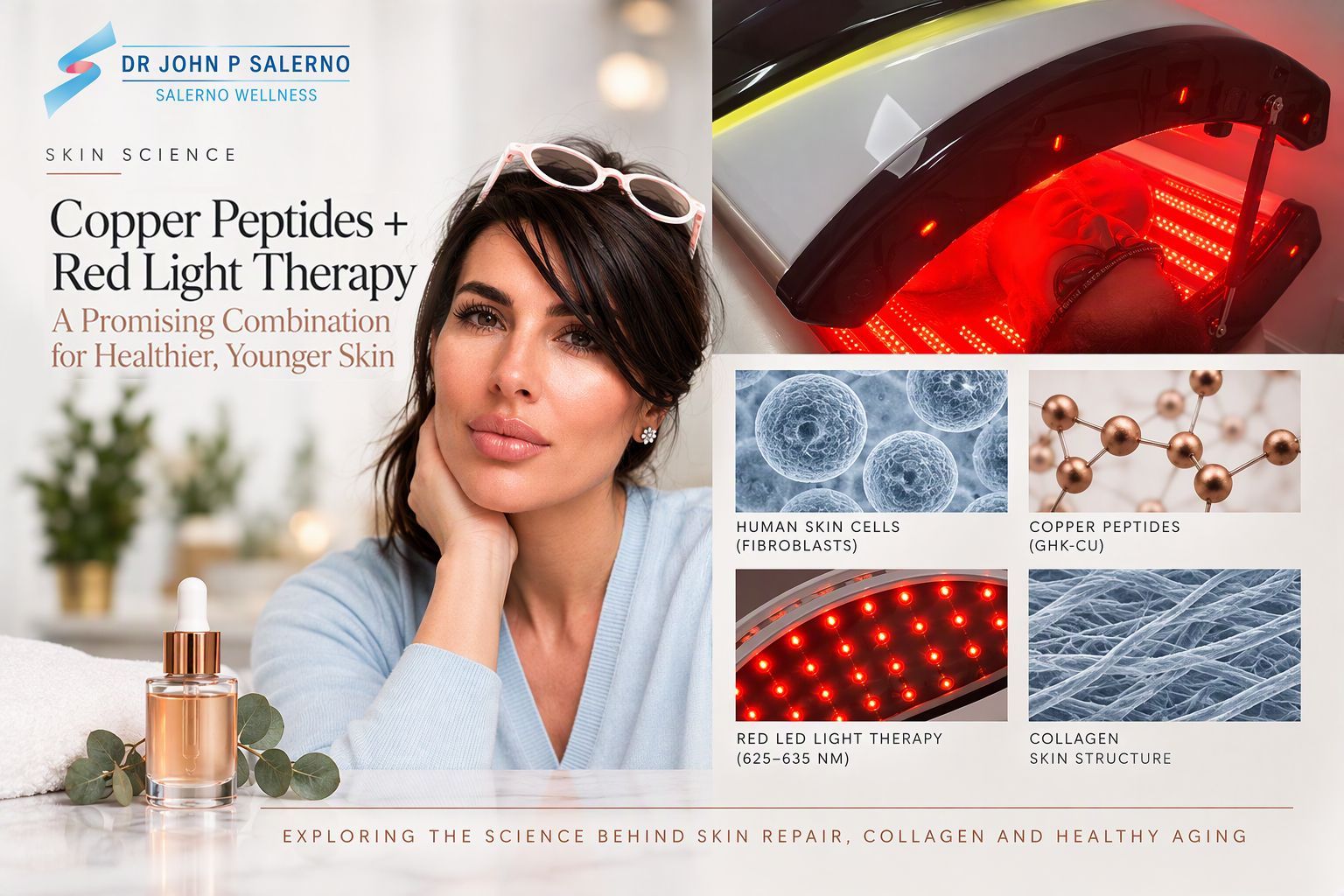
One particularly interesting area of research involves combining GHK Cu copper peptides with red light therapy. Researchers have studied each independently for its potential role in skin health. This week, let's learn what happens when we use them together. This week, let's take a closer look at what researchers have discovered and, just as importantly, what this research can and cannot tell us.
-Dr. John Salerno
What Are Copper Peptides?
GHK Cu is a naturally occurring copper-binding peptide that has attracted scientific interest for its potential role in tissue repair, collagen production, and skin regeneration. Our natural repair mechanisms change as we age. Collagen production declines, skin thins, elasticity changes, and damage accumulated over decades becomes increasingly visible.
Collagen is particularly important because it provides much of the structural support that helps skin maintain its strength and firmness. When collagen production and remodeling change with age, we begin to see some of the characteristics we associate with older skin.
The goal of regenerative skincare isn't simply to cover up those changes. The more interesting question is whether we can better support the cellular processes responsible for healthier skin. That's one reason copper peptides have become such a focus of research.
What Does Red Light Therapy Do?
Red light therapy uses specific wavelengths of visible red light to interact with cells without damaging the skin's surface. Rather than creating an injury that the skin must heal from, red light therapy is being studied for its ability to influence cellular activity and support natural repair processes.
For skin rejuvenation, researchers are particularly interested in its potential effects on fibroblasts. These cells help produce collagen and maintain the structural framework of our skin.
Think of fibroblasts as part of the skin's internal maintenance system. Their activity matters because healthy skin isn't static. It is continually responding to environmental exposure, normal wear, inflammation, and the biological changes associated with aging. This shift in perspective is important. Skin rejuvenation doesn't necessarily have to start with the wrinkles we see in the mirror. It can begin by asking what is happening within the skin itself.
What Happens When Copper Peptides and Red Light Are Combined?
This is where the research gets especially interesting. A study published in Photomedicine and Laser Surgery examined human skin fibroblasts exposed to GHK Cu copper peptides along with red LED light at 625 to 635 nm. The researchers evaluated cellular activity and viability, along with measures related to Type I collagen and basic fibroblast growth factor. Researchers observed encouraging changes involving:
- Cellular activity - Improvements in fibroblast viability were observed under certain experimental conditions.
- Growth factors - The combination increased basic fibroblast growth factor production, which is involved in cellular processes associated with tissue repair.
- Collagen support - Researchers observed increases in measures associated with Type I collagen production when LED treatment was followed by Cu GHK incubation.
The idea is fascinating because the two approaches may influence cellular processes in different but potentially complementary ways.
Why Combining Treatments May Be the Future of Skin Rejuvenation
One principle I emphasize at Salerno Wellness is that we shouldn't view the body as a collection of isolated problems. Skin is no different. Healthy skin depends on many interconnected biological factors, including cellular function, circulation, hormones, nutrients, inflammation, oxidative stress, collagen production, and the body's ability to repair itself.
That is why a comprehensive approach to skin rejuvenation can be more interesting than relying on a single treatment. Depending on the individual, a skin rejuvenation program may incorporate treatments such as:
- Red Light Therapy - Red Light Therapy is designed to expose the skin to targeted wavelengths of light being studied for cellular function, collagen support, and skin rejuvenation.
- GHK Cu Copper Peptides - Peptides being investigated for their potential role in tissue repair, collagen production, and regenerative processes.
- Laser and Light-Based Treatments - Laser and light rejuvenation technologies can be selected based on the patient's skin, goals, and specific cosmetic concerns.
- Longevity Support - Longevity medicine looks beyond the skin's surface to factors such as nutrition, hormones, metabolic health, inflammation, and other influences on healthy aging.
The important point is that skin doesn't exist separately from the rest of the body. What we see externally can be influenced by what is happening internally. For me, that is where skin rejuvenation becomes much more interesting than simply treating a line, wrinkle, or age spot. We can begin looking at skin as part of the larger biology of healthy aging and longevity.
The Future Isn't About "Anti-Aging"
I think we're moving beyond the old idea that aesthetic medicine should try to reverse aging. We cannot stop aging. We can continue investigating how nutrition, hormones, peptides, light, metabolism, cellular function, and other factors influence how our bodies age.
Research such as the copper peptide and red light study gives us another piece of that much larger puzzle. It doesn't provide every answer, but it helps us understand the biological pathways researchers are exploring and why combinations of therapies are receiving attention.
The future of skin rejuvenation may be less about fighting age and more about helping the body's own repair and renewal systems work as effectively as possible.
If you're interested in learning whether our skin rejuvenation and longevity treatments may be right for you, please get in touch and schedule a consultation.
Please contact us online or call us at (212) 582-1700 in New York City or (475) 269-2138 in Connecticut to schedule an appointment.